How Scenario Planning Strengthens Business Strategy and Risk Management
 June 08, 2026
Most business plans are built on a single set of assumptions. One growth rate, one cost projection, one view of how the market will behave. That works reasonably well when conditions are stable, but they rarely remain so for long. Demand shifts, interest rates move, supply chains fracture, regulations change. When any of these happens, a plan built on one forecast has no answer.
Scenario planning was designed for exactly this gap. Rather than asking what is most likely to happen, it asks what could happen across a range of plausible futures and what a business would do in each case. The result is a more honest, more resilient approach to long-term business strategy that has been adopted by organizations from multinational energy firms to small business owners managing seasonal cash flow.
The Core Idea Behind Scenario Planning
At its foundation, scenario planning is a structured method for building multiple internally consistent futures, quantifying their financial effects, and defining the actions appropriate to each one. A standard scenario set typically includes a base case, an upside case, a downside case, and sometimes an extreme stress case. Each one is built from a coherent set of assumptions rather than random number changes.
The practice originated in military strategy and war-gaming techniques developed for the Pentagon in the 1960s, then gained commercial traction through Shell’s planning team in the 1970s. Shell used scenario planning to anticipate changes in the oil market, which positioned the company to adapt when oil prices collapsed in the 1980s. What began as a qualitative exercise in imagining alternative futures has since evolved into a combination of narrative, quantitative modeling, monitoring dashboards, and predefined action plans.
Scenario Planning vs Forecasting
The distinction between forecasting and scenario planning matters because the two approaches are designed to solve different problems.
Traditional forecasting is built around a single expected outcome. It uses historical data, current trends, and assumptions about future conditions to estimate what is most likely to happen. A finance team might forecast next year’s revenue growth at 8%, project operating costs based on current inflation trends, and build a budget around those assumptions. Forecasting is valuable for operational planning because businesses still need targets, budgets, and performance benchmarks.
The limitation is that forecasts often assume the future will behave in a relatively linear and predictable way. When conditions change sharply, a single forecast can become outdated very quickly.
Scenario planning approaches uncertainty differently. Instead of focusing on one expected future, it explores several plausible futures at the same time. The goal is to understand how different conditions would affect the business and what actions management would take in response.
For example, a forecast might estimate revenue growth under expected market conditions. Scenario planning asks additional questions: What happens if customer demand weakens by 20%? What if interest rates remain elevated for another two years? What if supply chain disruptions increase costs while sales slow simultaneously? Rather than producing one answer, scenario planning produces a range of possible outcomes and corresponding action plans.
Another important difference is behavioral. Forecasting tends to encourage confidence in a single plan, while scenario planning encourages preparedness and adaptability. Forecasting is primarily about prediction. Scenario planning is primarily about resilience.
In practice, strong organizations use both together. Forecasts provide the baseline operating plan. Scenario planning stress-tests that plan against uncertainty and helps leadership prepare for conditions where the forecast no longer holds true.
Where Scenario Planning Shows Up in Practice
Business scenario modeling appears across a wide range of decisions and functions, which is part of what makes it worth understanding clearly. It is most commonly used in the following areas:
-
Annual budgeting and forecasting: Where finance teams need to communicate a range of outcomes rather than a single figure
-
Capital expenditure decisions: Where large, often irreversible investments need to be stress-tested against demand and cost scenarios before approval
-
Cash flow and liquidity management: Particularly for startups and highly leveraged companies where runway matters as much as profitability
-
Credit underwriting and covenant monitoring: Where lenders model borrower performance under adverse conditions to set appropriate terms
-
Equity valuation: Where analysts build pessimistic, expected, and optimistic scenarios for earnings and multiples to establish a defensible price range
-
Strategic planning: Where leadership teams stress-test a three to five year plan against scenarios involving regulation, competition, or macro shifts
The same logic applies at a policy level. Central banks model GDP growth under different inflation and rate paths. Finance ministries use scenario analysis to estimate tax revenue under recession and recovery conditions. Regulatory bodies run stress tests on financial institutions to assess systemic resilience. The method scales from a neighborhood restaurant owner building three seasonal demand cases to a bank managing portfolio credit risk across thousands of borrowers.
How the Scenario Development Process Works
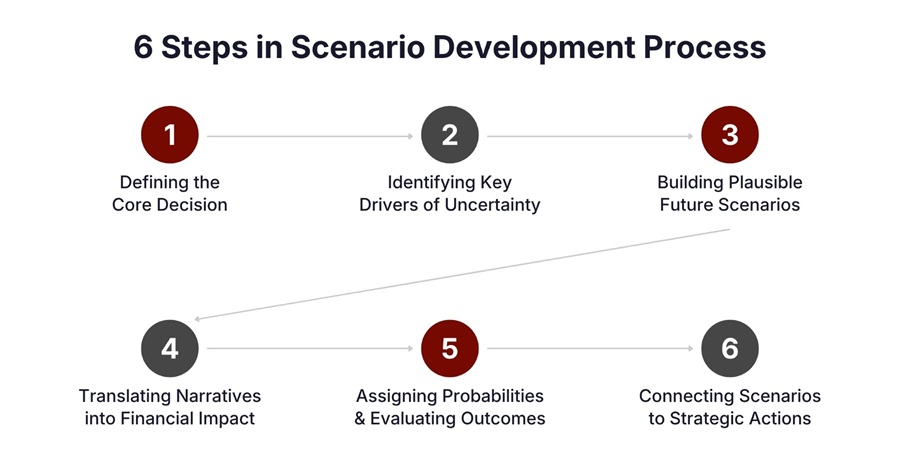
While scenario planning does not follow a single universal formula, the process typically moves through a recognizable sequence. Understanding each step is what separates a useful exercise from a presentation that gets filed away.
1. Defining the Core Decision
The starting point is a clearly defined decision. Without this, scenario planning drifts into storytelling. The question might be: can the company survive a 25% drop in demand? Should we proceed with the new plant? Is the acquisition viable if interest rates stay elevated? The decision determines which assumptions and metrics matter.
2. Identifying the Key Drivers of Uncertainty
In this, teams identify the key drivers of uncertainty. These are variables that most influence outcomes and that the organization cannot fully control: sales volume, pricing, raw material costs, foreign exchange rates, borrowing costs, customer churn, default rates, or regulatory changes. A common mistake at this stage is including too many drivers. Three to five well-chosen variables produce more coherent, usable scenarios than a sprawling list of fifteen.
3. Building Plausible Future Scenarios
The drivers are then combined into narratives that describe different plausible futures. A downside narrative might read: demand weakens across two quarters, input costs remain elevated, and receivables collections slow. An upside narrative might describe a faster-than-expected demand recovery with stabilizing margins. These narratives serve a practical purpose: they keep the assumptions internally consistent. If the story is weak, the scenario is likely unrealistic.
4. Translating Narratives into Financial Impact
Narratives translate into changes to revenue, margin, operating cash flow, ability to meet debt payments, the flexibility allowed by financial agreements, or whatever financial outputs matter for the decision. This is where the scenario development process becomes finance rather than strategy.
5. Assigning Probabilities and Evaluating Outcomes
A probability-weighted expected value can be calculated where useful: multiply each scenario’s outcome by its assigned probability and sum the results. That said, probabilities should be assigned carefully and with humility. In many cases, the goal of scenario planning is preparedness rather than prediction and forcing false precision onto likelihoods can undermine the exercise.
6. Connecting Scenarios to Strategic Actions
The final and most often neglected component is linking scenarios to actions. What does the company do if the downside signals appear? Freeze hiring? Reduce capex? Increase hedging? Without predefined responses, scenario planning produces insight without behavior change, which is where many organizations leave value on the table.
Why Scenario Plans Fail in Practice
The technical work of building scenarios is rarely where the process breaks down. The more common failures are organizational. Shell’s original scenario project in 1970 produced prescient energy scenarios that were ignored because the exercise did not involve enough senior leaders. A U.S. transportation company built compelling electric vehicle scenarios that the planning team was reluctant to present to the C-suite because the scenarios felt too speculative. A municipal utility completed a thorough water demand and supply scenario exercise that fell on deaf ears because operational managers did not know what to do with the output.
These examples point to a consistent pattern. Scenario planning is a useful starting point, but it rarely delivers value in isolation. What it needs around it is an adaptive strategy that maintains flexibility rather than locking the organization into a single path, a dynamic monitoring system that tracks real-world indicators against the scenarios in real time, enough organizational agility to act on what the monitoring reveals, and leadership that is genuinely comfortable with uncertainty rather than treating it as an intrusion into a clean plan.
Without these supporting practices, scenario outputs become a document that is presented once and then shelved. With them, scenario planning becomes a living system that improves decision quality across planning cycles.
Conclusion
The organizations that get sustained value from scenario planning share a few characteristics. They start with a clearly defined decision rather than a general desire to understand the future. They limit their drivers to the variables that genuinely matter. They test their downside cases honestly and link them to specific management actions. They monitor real-world indicators against their scenario assumptions on a rolling basis and update their plans when the data warrants it.
The process does not require sophisticated modeling software or a large finance team. A small business owner can build three cash flow cases in a spreadsheet and make better inventory and hiring decisions as a result. The process requires intellectual rigor and honesty about uncertainty, discipline in keeping scenarios coherent, and the willingness to act on what the analysis reveals before conditions force the decision.
Scenario planning will not eliminate uncertainty from business decisions; nothing will. What it does is replace the false confidence of a single forecast with a clearer view of the range of futures a business might face and what it would do in each one. That is a more accurate picture of reality, and decisions made from a more accurate picture of reality tend to hold up better when the future arrives.
Frequently Asked Questions
1. What is scenario planning in business?
Scenario planning is a strategic planning method that helps businesses prepare for multiple possible futures instead of relying on a single forecast. It involves building different scenarios based on changing market, financial, operational, or economic conditions and defining how the business would respond in each case.
2. How is scenario planning different from forecasting?
Forecasting estimates the most likely future outcome based on current data and trends. Scenario planning examines several plausible futures, including downside and stress cases, to help organizations prepare for uncertainty and make more resilient decisions.
3. What are the main types of business scenarios?
Most organizations use a combination of:
-
Base case scenarios
-
Upside or optimistic scenarios
-
Downside or pessimistic scenarios
-
Stress-test or extreme disruption scenarios
These help leadership evaluate risks, opportunities, and contingency plans under different conditions.
4. Who should be involved in the scenario planning process?
Effective scenario planning typically involves finance teams, senior leadership, operations, strategy teams, and department heads. Including decision-makers across functions improves the realism of assumptions and increases the likelihood that the resulting actions will actually be implemented.
5. How often should businesses update their scenarios?
Scenario plans should be reviewed regularly, especially when market conditions, customer behavior, interest rates, regulations, or supply chain conditions change significantly. Many organizations revisit scenarios quarterly or alongside annual planning cycles.